

Technical Comparative Analysis:Compare Lunar.dev MCPX vs. TrueFoundry

While both Lunar.dev MCPX and TrueFoundry provide foundational connectivity; their architectural philosophies diverge sharply.

Strategic decision-makers must distinguish between a platform designed for rapid, UI-driven prototyping and one engineered for high-availability resilience, identity-scoped isolation, and rigorous security governance.

Foundational Comparison: Functional Parity and Shared Concepts

Both Lunar.dev and TrueFoundry address the "fragmented infrastructure" problem by centralizing MCP connections. Without a gateway, organizations face "credential sprawl" and "IT zero visibility," where API keys are scattered across local developer environments. Centralizing these connections into a unified registry allows enterprises to transition to a governed state where every tool invocation is auditable.

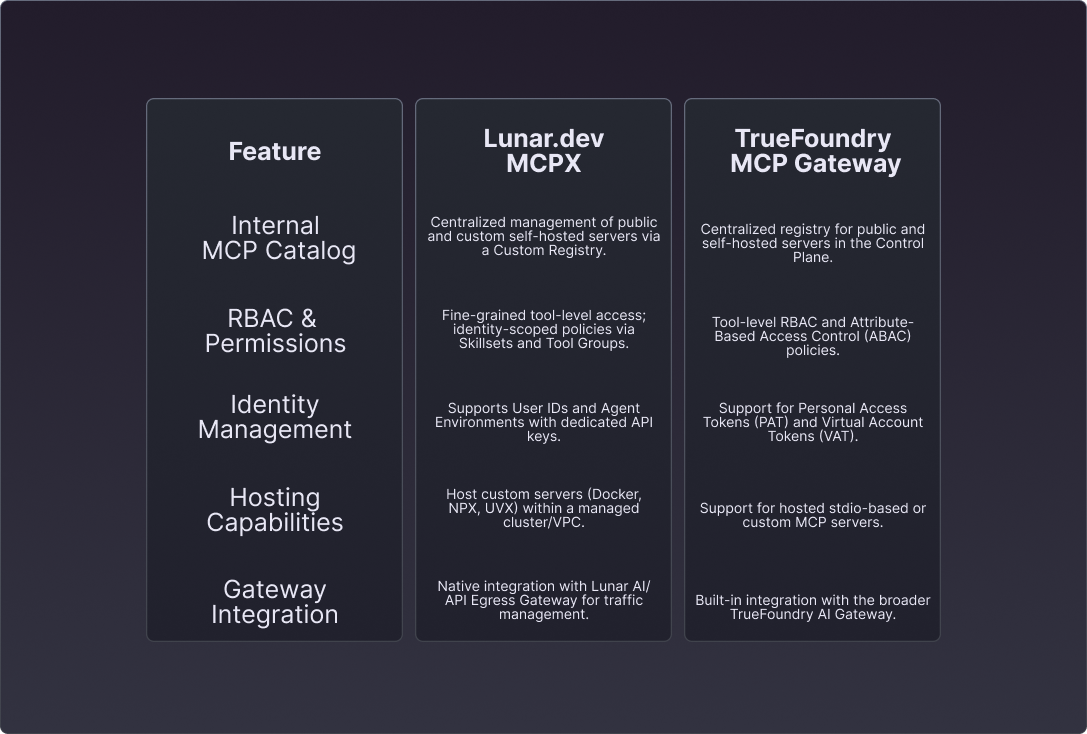
Foundational Feature Parity

The "So What?" of Shared Capabilities

The primary business outcome of these shared features is the mitigation of Excessive Agency (OWASP LLM08). By moving from "Before" (unmanaged tool sprawl) to "After" (Unified Registry), administrators can define exactly which tools an agent is eligible to use. This centralized oversight eliminates the risk of agents discovering and exploiting sensitive, unvetted tools that were previously "hidden" in fragmented developer configurations.

Architectural Rigor: Microgateways vs. Proxy Planes

Architectural design determines system isolation, throughput, and the granularity of forensic auditing. In high-traffic environments, a failure in a single agent workflow must not compromise the entire ecosystem.

Contrast in System Design

  • TrueFoundry

    Utilizes a Gateway Plane architecture built on the Hono framework. It functions as a stateless proxy that performs in-memory checks for authentication and rate-limiting, utilizing NATS for real-time configuration syncing from the control plane. This model is optimized for performance, capable of handling 250–350 RPS per pod with minimal overhead.

  • Deterministic tool execution

    Chain tools into fixed, policy-controlled flows to ensure predictable agent behavior.

Observability and Data Persistence

  • How Lunar works, high-level Agent boundary enforcement

    Lunar sits between agents and MCP servers, APIs and internal systems. It inspects intent, permissions and context before allowing actions to proceed.

  • Persistence Models

    TrueFoundry relies on its internal UI dashboards, backed by a Clickhouse/BlobStorage logging backend. While efficient for high-level monitoring, Lunar’s OTEL-native approach allows for better integration into enterprise-wide SIEM and observability platforms.

  • Audit Trails

     Lunar’s architecture collects metrics at the individual Agent Environment level, providing a forensic-level audit trail that surpasses aggregated gateway metrics.
The Security Frontier: Proactive Governance and Risk Mitigation

In an MCP-enabled environment, the attack surface includes tool poisoning and prompt injection. A security-first mandate is required to operationalize OWASP recommendations through a risk-scoring engine.

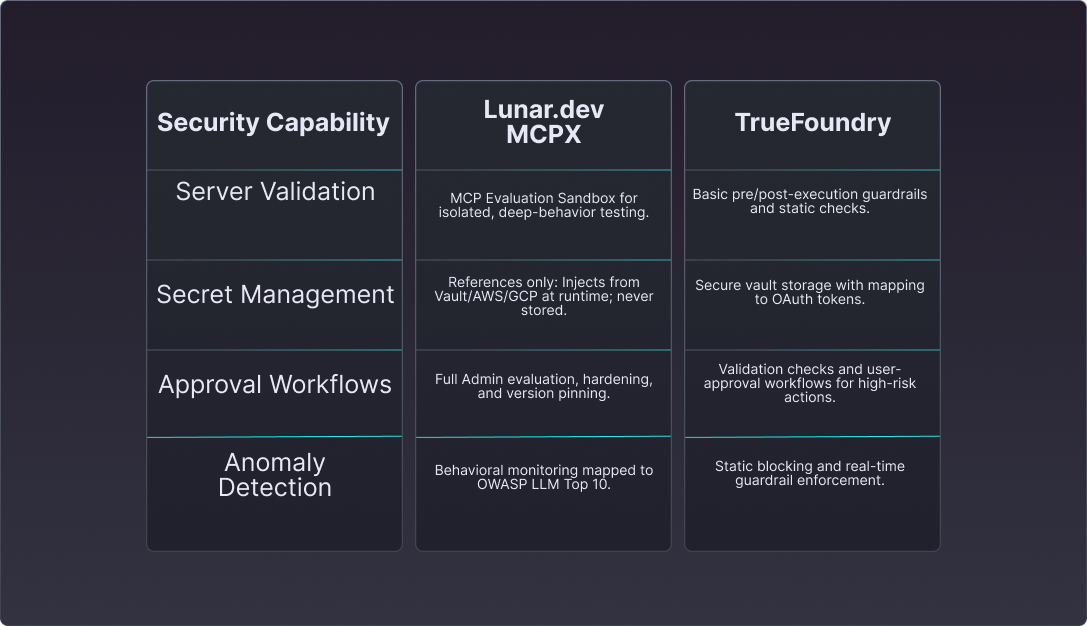
Security & Risk Mitigation Matrix

Lunar.dev Deep-Dive: Hardening and Sandboxing

Lunar.dev maps its security features directly to the OWASP Top 10 for LLMs:

  • MCP Evaluation Sandbox

    Admins test server behavior (permissions, token usage) in total isolation before promotion. This provides critical protection against "Rug Pulls" (where a server updates silently to a malicious version) and Version Drift.

  • Risk-Scoring Engine

     Automatically classifies tools into Critical, High, Medium, or Low risk, specifically targeting LLM01 (Prompt Injection) and LLM08 (Excessive Agency).

  • Secret Management

    Structurally, Lunar never stores or manages secrets. It references them from providers like HashiCorp Vault or AWS Secrets Manager and injects them at runtime. Credentials are never exposed to users or configuration files.

  • Hardening

    Admins can "harden" tools by restricting parameters (e.g., limiting a file tool to a specific directory) before releasing secure versions to the registry.

Operationalizing Intelligence: Advanced Agent Features

The "Tool Overload" problem is the primary bottleneck for production agents. Exposing an agent to a 50-tool catalog can consume 77,000 tokens in definitions alone, causing context bloat, increased latency, and reasoning degradation.

  • Intent-Based Discovery vs. Static Injection

    Lunar.dev utilizes Intent-Based Discovery to solve context management. Using the defer_loading: true flag and a search primitive, the gateway moves from "Static Injection" to "Dynamic Selection"

  • Skillsets and Skill Portability

    In the Lunar ecosystem, a Skillset acts as the primary container, holding specific Tool Groups and MCP Prompts. This allows architects to build "Financial Analyst" or "DevOps" skillsets that are shared across agents and teams, ensuring consistent, deterministic behavior.

  • Tool Customization

    Lunar's tool customization allows organizations to fine-tune and carefully scope the specific tools, parameters, and permissions an AI agent can access, even enabling administrators to instantly toggle specific tool functions (like read versus write access) without modifying any underlying code.

    By organizing capabilities into curated "Tool Groups" tailored for specific workflows, this customization significantly improves the agent's decision-making accuracy by eliminating distracting or ambiguous options

  • TrueFoundry Counterpart: Virtual MCP Servers

    TrueFoundry provides Virtual MCP Servers, which allow administrators to combine tools from multiple servers into a curated subset. While effective for basic tool scoping, it currently only supports listing and calling tools. Lunar.dev extends this capability by supporting MCP Prompts as runtime control surfaces, enabling prompts to encode intent explicitly and guide the agent’s reasoning mode from the start.

Strategic Recommendation

The choice between Lunar.dev and TrueFoundry is a choice between a connectivity proxy and a governance infrastructure.

Decision-Maker’s Checklist

  • Choose TrueFoundry if:

    You require a simple, UI-driven playground for rapid prototyping and basic guardrails.

    ABAC-based policy management is a requirement for a smaller, centralized development team.

  • You require a high-availability Microgateway Architecture deployed within your VPC/cluster for data residency.

    Rigorous security is paramount, requiring an MCP Evaluation Sandbox with drift detection and "Rug Pull" protection.

    You must optimize context windows and costs through Intent-Based Discovery and defer_loading mechanisms.

    You require full lifecycle governance of the MCP ecosystem, including secret referencing, tool hardening, and OWASP-aligned risk scoring.