MCP Gateway Comparison:Lunar.dev MCPX vs. Runlayer
Compare Lunar.dev MCPX with Runlayer. Lunar.dev is the MCP Gateway for secure and governed tool access.Runlayer is an enterprise MCP catalog and security platform.
Runlayer is an enterprise MCP security platform. It provides a catalog of pre-vetted MCP servers, SSO integration, and threat detection, all SaaS-hosted.
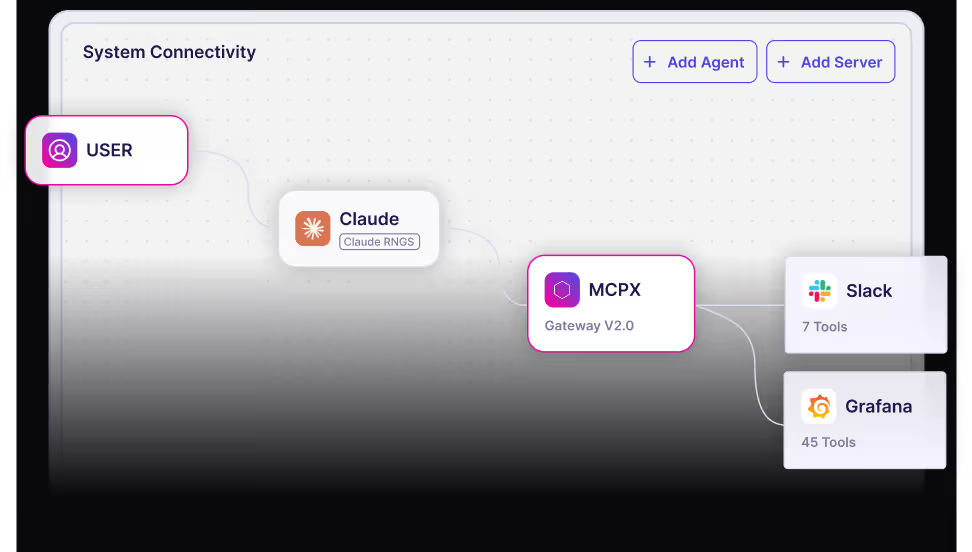
Lunar.dev MCPX is the MCP Gateway for secure and governed tool access. It sits between AI agents and MCP servers, intercepting, authenticating, and governing every tool invocation using policies defined by your organization. Deploy in your VPC, on site, or in isolated networks.
Why teams choose Lunar.dev over Runlayer
Both platforms govern MCP traffic. The difference is architecture and focus. Lunar.dev is a self-hosted MCP gateway with identity-bound policies. Runlayer is a SaaS security layer with a curated server catalog.
Four things set Lunar apart.
1.
MCP Risk Evaluation Sandbox
Test server behavior (permissions, token usage) in total isolation before deployment. Protects against the security risks of MCP servers - rug pull, tool poisoning, and version drift - ensuring a secure version of the internal MCP catalog.
2.
Dynamic tool discovery
Lunar's implementation of Anthropic's tool search - progressive disclosure in MCP that loads tool capabilities incrementally rather than flooding the LLM context upfront. Prevents context overload, improves response performance, and reduces token costs.
3.
Centralized MCP and Skills inventory
Maintain a shared catalog of approved MCP servers and Skills across your organization. Teams publish to the central inventory, agents discover from it - ensuring consistent, governed access to company resources without duplicating configurations or managing credentials in individual setups.
4.
Seamless Experience for Non-Technical Users
Unlocking AI adoption for business personas Admins pre-configure and "harden" tools with built-in restrictions before publishing them to the internal catalog. Authentication and guardrails run behind the scenes - business users access AI tools directly from their workspace without configuring credentials, policies, or ever seeing Lunar's infrastructure.
Side-by-side comparison
A quick look at how the two platforms stack up across the dimensions that matter for production MCP deployments.
Feature
Internal MCP Catalog
RBAC & Permissions
Dynamic tool Discovery
Hosting Capabilities
AI Gateway Integration
Skills
Security & Risk Mitigation Matrix
Security Capability
Server Validation
Secret Management
Approval Workflows
Anomaly Detection
Where the platforms overlap
Both Lunar.dev and Runlayer centralize MCP connections so every tool invocation is auditable instead of scattered across local developer environments. Both support enterprise identity providers like Okta and Microsoft Entra. Both are SOC 2 certified. Both target enterprise IT and security teams.
The difference is what each platform optimizes for: Runlayer is built around catalog access and identity-managed permissions; Lunar.dev is built around governing the runtime traffic between agents and the tools they use.
Enable adoption, don't block it
Lunar gives teams approved tools with guardrails that stay out of the way. rewrite this
Intent-based discovery vs. static injection
Lunar.dev utilizes Intent-Based Discovery to solve context management. Using the defer_loading: true flag and a search primitive, the gateway moves from "Static Injection" to "Dynamic Selection"
Skills and Portability
In the Lunar ecosystem, a Skillset acts as the primary container, holding specific Tool Groups and MCP Prompts. This allows AI developers to build agnostic skills that are shared across agents and teams, ensuring consistent, deterministic behavior.
Tool Customization
Lunar's tool customization allows organizations to fine-tune and carefully scope the specific tools, parameters, and permissions an AI agent can access, even enabling administrators to instantly toggle specific tool functions (like read versus write access) without modifying any underlying code.
Architecture
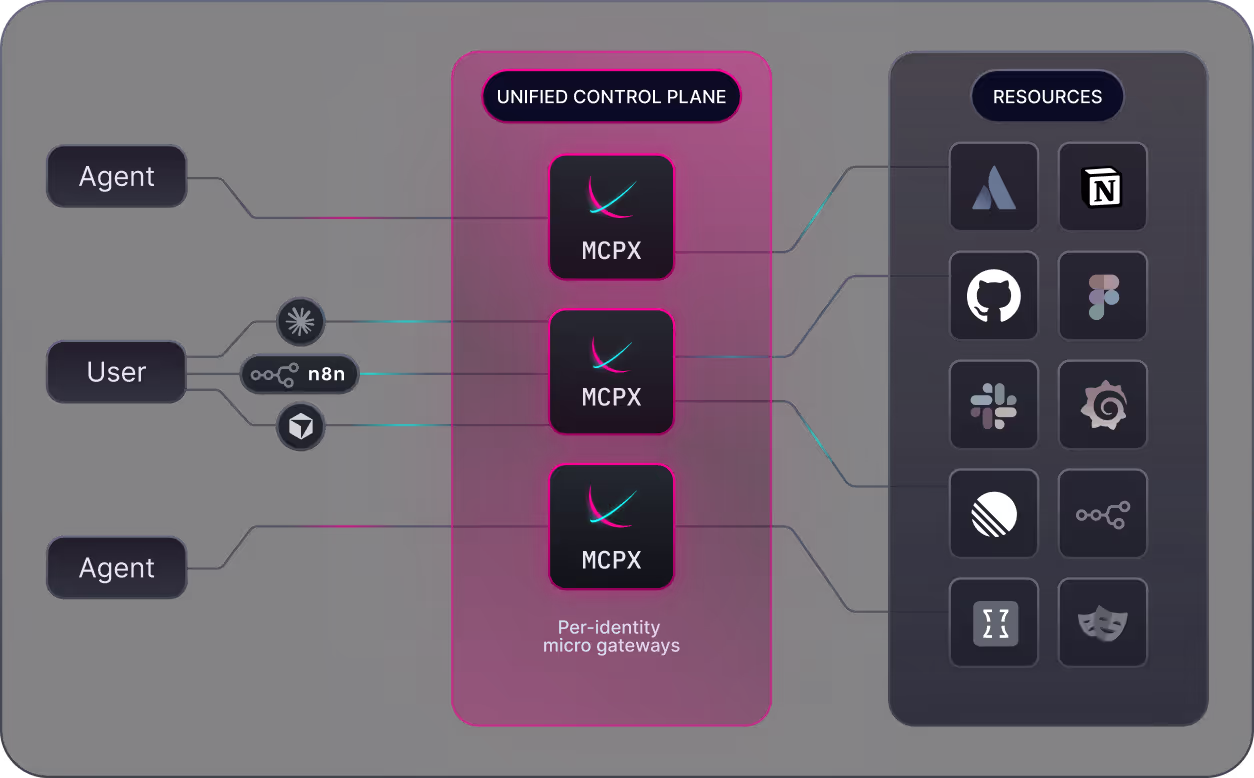
Lunar.dev sits between agents and the systems they use (MCP servers, APIs, internal tools) as a dedicated focal point for every agent-to-resource interaction. Each agent environment has its own enforcement boundary and its own audit trail. TrueFoundry runs a single proxy plane shared across agents, optimized for raw throughput.
Contrast in System Design
A centralized gateway routes all MCP traffic through a single control plane. Agents share a common proxy surface with identity-managed permissions. Access is governed via a curated catalog.
A microgateway runs per agent environment, each with its own enforcement boundary and its own audit trail. A failure or misuse in one workflow stays contained. Tool calls follow policy-controlled flows so agent behavior stays predictable.
Observability and Data Persistence
Full lineage by default
Lunar captures lineage across user, agent, model, MCP server, and the final tool or API invocation, mapping every action to a verified user identity. TrueFoundry surfaces aggregated gateway metrics in its internal UI.
Real-time audit trails to your SIEM
Lunar produces immutable, real-time logs of all agent activity, exported via OpenTelemetry to Splunk, Datadog, Grafana, or any SIEM your security team already runs. TrueFoundry persists logs to a Clickhouse and blob-storage backend behind its own dashboards.
Identity-aligned attribution
Lunar's architecture collects metrics at the individual Agent Environment level, providing a forensic-grade audit trail. That means visibility into who did what, with which tool, against which system. Aggregated gateway metrics can't answer those questions at the same resolution.
Which to choose
The decision comes down to Enterprise-grade readiness and aloowing ai enablement across the entire enterprise for both devleoprs and non tech . Are you looking for a centrelised sulotion to mange access for agents and users via a dedicated MCP gateway soultion, or an AI platform that includes a gateway among many other things?
Choose Runlayer if:
You're looking for a curated MCP catalog with SSO access for your team
Your governance focus is on the user-to-MCP-server layer
Choose Lunar.dev if:
You want a dedicated MCP gateway focused on Enterprise governance, security, and visibility.
You need unified governance for agents accessing Skills, MCP servers, APIs, and LLMs
Security is critical - you require testing server behavior in isolation before deployment to protect against rug pull, tool poisoning, and version drift
You must optimize context windows and costs through Intent-Based Discovery and defer_loading mechanisms.
You require full lifecycle governance of the MCP ecosystem, including secret referencing, tool hardening, and OWASP-aligned risk scoring.
Frequently asked questions
Is Lunar.dev MCPX an alternative to Runlayer?
Lunar.dev MCPX is a dedicated MCP gateway. Runlayer is also MCP-focused but differs in architecture. Runlayer is an MCP catalog and access platform. Lunar.dev MCPX is an MCP runtime gateway: per-agent micro gateways, isolated enforcement, policy-controlled tool access. If you want runtime control over what agents do, Lunar.dev is the choice.
What does Lunar.dev MCPX do that Runlayer doesn't?
A dedicated, policy-enforced workspace per user that isolates failures inside individual workflows. A risk evaluation sandbox that tests MCP servers before production, the only gateway with pre-deployment threat analysis. Reference-only secret management that never stores credentials in the gateway. One unified audit trail across MCP, LLM, and API traffic.
Can Lunar.dev MCPX be self-hosted?
Yes. Lunar.dev MCPX deploys in your VPC, on site, or in isolated networks. Audit data exports via OpenTelemetry to Splunk, Datadog, Grafana, or any SIEM you already run. The MCPX core is open source on GitHub. The enterprise edition adds centralized management, RBAC, advanced auditing, and dedicated support.
Is Lunar.dev MCPX open source?
Yes. The MCPX core is open source. The enterprise edition is built for production with centralized management, role-based access control, advanced auditing and observability, and dedicated support.
Does Lunar.dev MCPX work with any LLM provider?
Yes. Lunar.dev MCPX is model-agnostic. It governs the MCP traffic between your agents and your tools regardless of which model you use. Bring any model strategy and Lunar governs the rest
Faster AI Adoption. Zero Loss of Control.
Adopt an enterprise MCP gateway now, then unify governance across LLM and API traffic as usage scales.